
Application &
admission
APPLY NOW
ADMISSION CRITERIA
… of all MIPDaL consortium partners are the following:
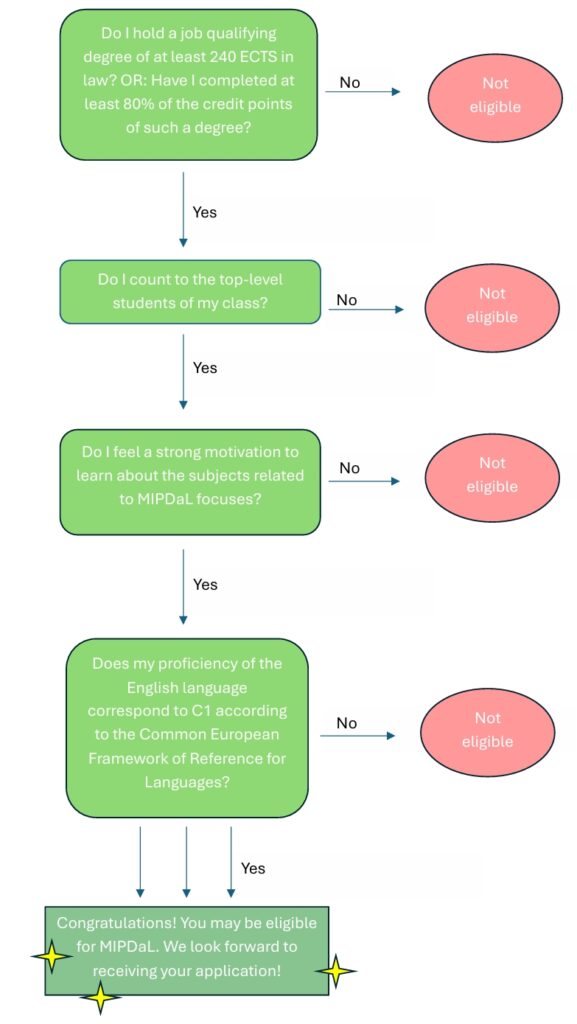
- The two countries of study are not identical to the student’s country of residence at the time of enrolment.
- Successful applicants have obtained the job qualifying degree of at least 240 ECTS (four years) in law or law-related fields (e. g. in criminology or jurisprudence), according to the regulations of the country where they have obtained their degree(s) and which is recognized in all countries of the participating Partners: Estonia, France, Germany, Spain and the United Kingdom (e. g. a three-year bachelor’s programme & a first master’s degree, or a four-year bachelor’s programme).
- If at the time of application, proof of the first university degree is not yet available due to candidates currently studying the said degree, the applicant will also be included in the assessment procedure if 80% of the credit points attainable through the university degree are already proven by means of completed module examinations or the final thesis and, if applicable, the colloquium by means of certification from the university of origin. The requirement of submitting all other proofs mentioned with the application remain unaffected by this. A conditional offer will be made to meet the requirements by a specified date.
- Successful applicants count to the top-level students of their class. They should hold a Law degree, or a degree with substantial Law content, that the admitting partner institutions deem equivalent to a UK Bachelor degree with Upper Second Class honours. Not sure if your degree meets this requirement? If you like, you can check this using our conversion table. To do so, follow the link and scroll down to “Entry requirements”. Under “International”, select the country where you obtained your degree. Of course, we use this table only for general orientation and review each case individually, for example, because certain universities may have their own grading systems.
- Successful applicants show their motivation for the subjects related to MIPDaL focuses.
- Students must provide evidence that they have met the following language proficiency:
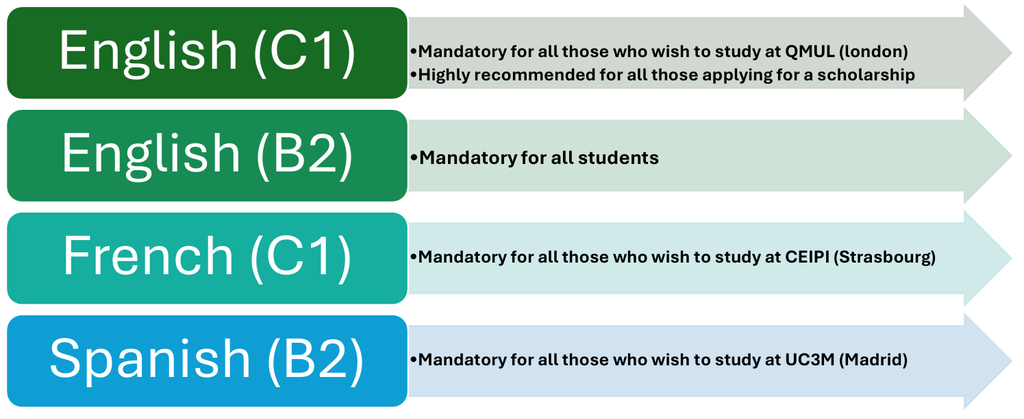
For degrees delivered in the English language, proficiency is required at C1 level (in execeptional cases B2+) according to the Common European Framework of Reference for Languages.
For degrees delivered also in the French (students choosing a study track including studies at UNISTRA) or Spanish (students choosing a study track including studies at UC3M) language, proficiency is required at C1 level (French) and B2 level (Spanish).
Based on our experience over the past few years, generally only applicants with a First Class degree and a C1 level of English have a chance of receiving an Erasmus Mundus scholarship.
Please note: In order to be eligible for a scholarship, all application documents must be submitted in full by January 15th!
TEACHING LANGUAGES & LANGUAGE CERTIFICATES
The MIPDaL teaching languages are English, French & Spanish and depend on the chosen study path:
- the teaching and examination language is exclusively English at TUD, TalTech, QMUL and UoE &
- the teaching and examination language is French at UNISTRA and Spanish at UC3M.
All applicants must prove their language skills with official certificates. (see below for exceptions)
English
The following language proficiency certificates are accepted, provided that the indicated minimum requirements are met:
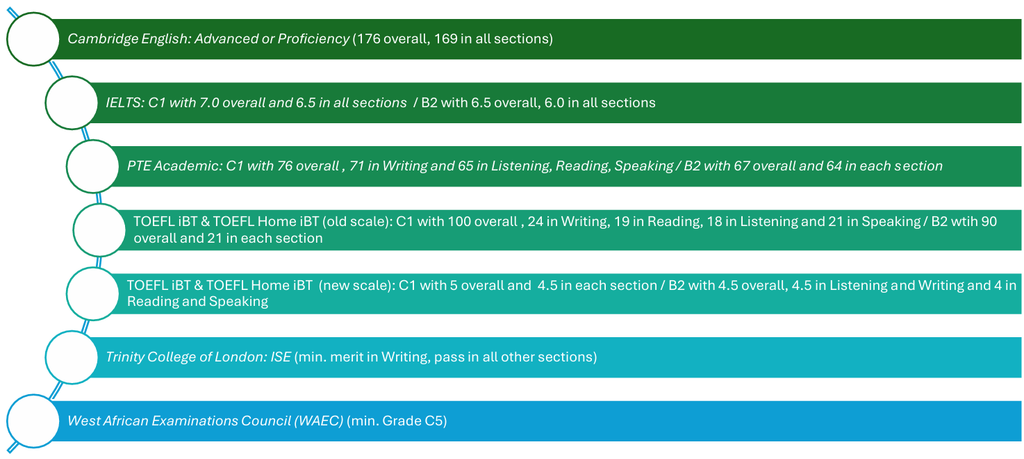
At the start of your MIPDaL studies, the tests are not permitted to be older than 2 years (CE, IELTS, PTE, TOEFL, ISE) respectively 5 years (WAEC). This ensures the basis for your academic success.
Level C1 is a strict condition for studying at QMUL. Furthermore, our experience shows that, as a general rule, only applicants with a C1 level in English have a realistic chance of securing one of our Erasmus Mundus scholarships.
Please note that only the listed language certificates can be accepted. No exceptions (MOI certificates etc.) will be made.
French
In order to study at UNISTRA you need usually French language proficiency at C1 level according to the Common European Framework of Reference for Languages.
We accept the following language tests: Diplôme approfondi de langue française (DALF) at C1 level, Diplôme d’études en langue française (DELF) at B2 level, TCF certificate at C1 level.
Spanish
In order to study at UC3M you need Spanish language proficiency at B2 level according to the Common European Framework of Reference for Languages.
The following language tests are accepted: Diploma de lengua española (DELE) at B2 level, Diploma del Servicio Internacional de Evaluación de la Lengua Española (SIELE) at B2 level.
In these cases you do not need to present a language certificate:
English
Please note: The following list is strictly binding. No exceptions will be made. We reserve the right not to respond to requests for exemptions from language tests.
- You are a native speaker from Canada or one of the following majority English speaking countries (MESC): Antigua and Barbuda, Australia, the Bahamas, Barbados, Belize, the British overseas territories, Dominica, Grenada, Guyana, Ireland, Jamaica, Malta, New Zealand, St Kitts and Nevis, St Lucia, St Vincent and the Grenadines, Trinidad and Tobago, UK, USA.
- You hold a degree from one of the following majority English speaking countries (MESC): Antigua and Barbuda, Australia, the Bahamas, Barbados, Belize, the British overseas territories, Dominica, Grenada, Guyana, Ireland, Jamaica, Malta, New Zealand, St Kitts and Nevis, St Lucia, St Vincent and the Grenadines, Trinidad and Tobago, UK, USA.
- You have studied in the UK before as a “Tier 4 (Child) Student”.
Spanish
- You are a native speaker from a Spanish-official speaking country.
- You hold a degree (also A-levels) from a Spanish-official speaking country.
French
- You are a native speaker from a French-official speaking country.
- You hold a degree (also A-levels) from a French-official speaking country.
Required
… documents have to be submitted by the applicant to the MIPDaL coordinator using the MIPDaL application portal. The following documents have to be uploaded (PDF preferred):
- Curriculum vitae (Europass format recommended)
- Copy of identification card
- Degree certificates of all studies at University level (e.g. Bachelor/Master degrees)
- Officially certified copy of university transcript of records (including official English translation)
- Proof of English, and if applicable, French or Spanish proficiency (officially certified copy
- Statement of purpose
- Academic reference letter (only valid with institutional letterhead and signature) (applicants who are out of university for at least three years are also allowed to submit a professional reference letter)
Applications that are not received in full, in due form or in due time are excluded from further proceedings. The MIPDaL Admissions Committee reserves the right to contact the authors of reference letters to verify the authenticity of the document.
With regard to the Statement of Purpose and the Reference Letter, we strongly recommend using our templates. These templates cover exactly what is relevant for our in-depth evaluation of the application. At the same time, we would like to emphasise that while we recommend using our templates, their use is not mandatory.
📆 Don’t Miss iT
Join us at our MIPDaL Admission clinics on 27 October and 1 December 2026, and on 4 January 2027. All sessions start at 3:00 pm CEST:
https://tu-dresden.zoom-x.de/j/66293813696?pwd=Kk10g8rAf0Hcwcxbb8rm3Ye5AT1pG8.1
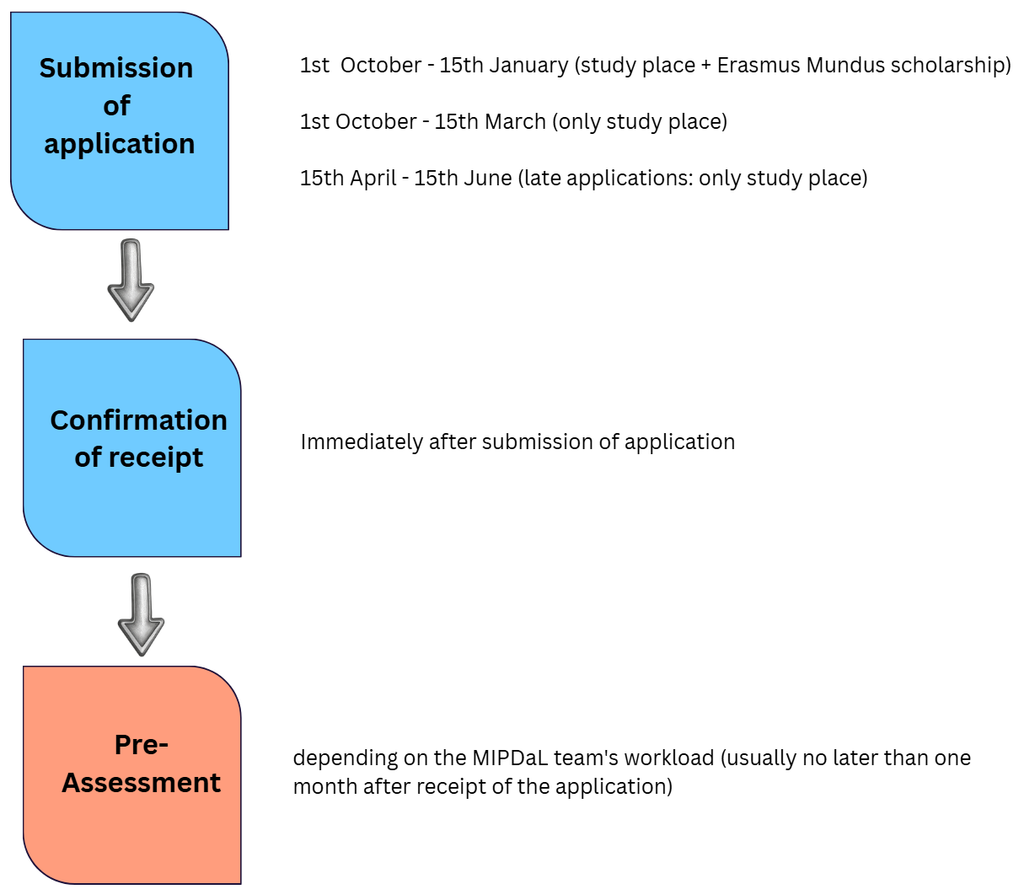
The Application …
… for the Master of Intellectual Property and Data Law (MIPDaL) for the academic year 2027/2028 is scheduled to open on October 1st.
The Application Deadline
- For all scholarship holders and “early birds” will be on 15th January 2027.
- All other applicants will be able to apply until 15th March 2027.
- Late applications will be possible until 15th June 2027.
To apply please click HERE.
Following selection …
… students will be contacted by the admitting institutions regarding the enrolment at the respective institutions. Further documents could be required before students are permitted to enrol (e. g. identification card, picture).
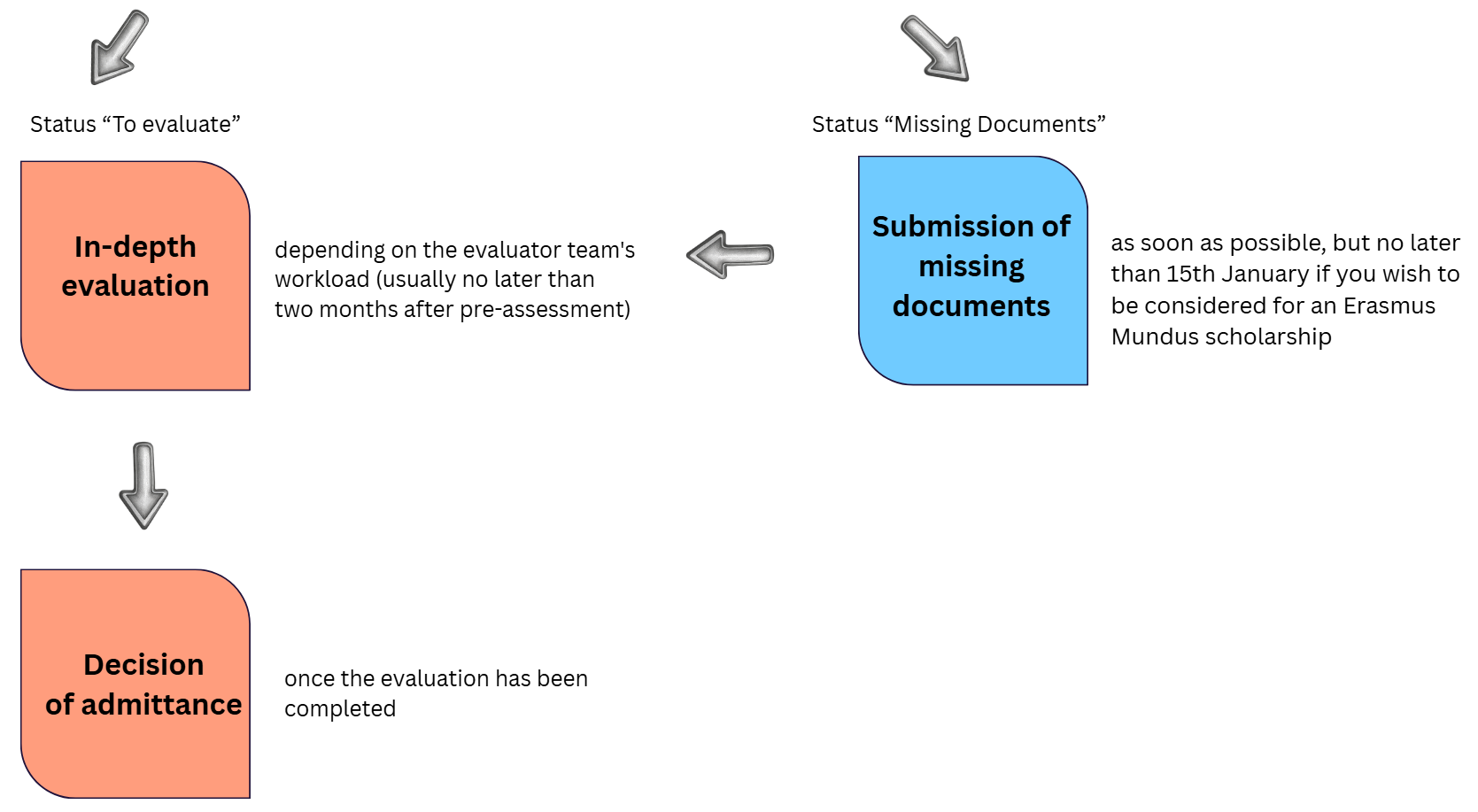
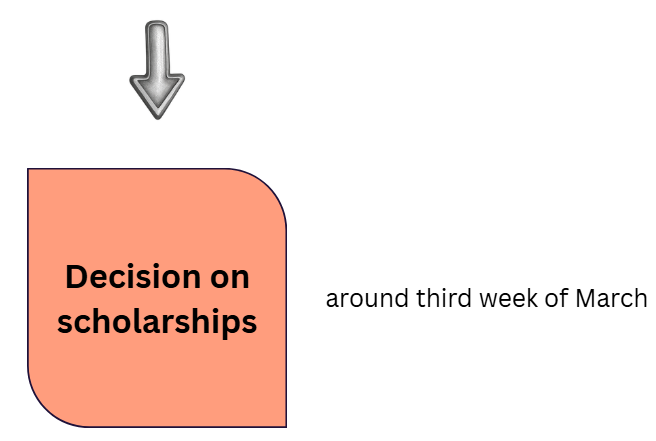
In general, applications undergo the following process:

Applications that do not meet the admission requirements or remain incomplete until the application deadline will not be forwarded for evaluation.
TIMELINE FOR THE APPLICATION AND ADMISSION PROCESS
Tuition Fees …
… are calculated on the basis of one academic year.
– The tuition fee for “European Students” (EU Member States & UK) is € 9.990.
– The tuition fee for “Non-European Students” is € 11,990.
Successful applicants will be required to pay the first non-refundable installment of €700 after acceptance. The remainder of the tuition fees is due 31st July and, upon withdrawal from the program, will be reimbursed as follows: 100% until 31st May; 50% until 15th September; no refund after that.
Top-Up Fee …
Students spending the 2nd semester at the UK partners, QMUL or UoE, are required to pay additionally a top-up fee. The exact amount of the top-up fee is established by the respective partners QMUL and UoE on an annual basis and is published on the common MIPDaL programme website at least 4 weeks before the beginning of the upcoming application period.
Current top-up fee for spending the 2nd semester at QMUL: £20,050
Current top-up fee for spending the 2nd semester at the University of Exeter: £12,000
Students receiving an Erasmus Mundus scholarship are exempted from paying the top-up fee.
Other Costs
The tuition fees cover the provision of the teaching, as well as some MIPDaL-related social activities. Additional costs for books and study materials vary per course and partner university. The responsibility to meet the costs of living (including accommodation) and travel expenses rests with the students.
Fees include …
… administrative and enrolment fees, student unions costs and insurance costs according to the current EACEA requirements.
Students are required to pay fees as defined above to the coordinating institution. Fees for scholarship holders are covered by the consortium.
Visa (-Related) Costs
If you come from a Non-EU country and need to apply for a visa, you will have to pay an application fee, which depends on the country of the university that will sponsor your visa. These fees will not be returned to you. Please check this website for the Intra EU Mobility visa.
Erasmus Mundus Scholarships
The MIPDaL programme offers a unique opportunity for potential students to take part in the program with scholarships funded by the European Commission. Up to 60 scholarships can be awarded throughout the program period of 5 years, allowing for a maximum of 12 students to be funded per year. Scholarship holders do not pay tuition fees to the consortium, nor additional fees to the UK partner universities. Additionally, they receive funding to cover their monthly expenses for accommodation, travelling, etc.
Eligibility: How are scholarship recipients selected from the pool of all applicants?
Our scholarship recipients are selected through a comparative, multi-stage process. Only applicants who meet all admission requirements and have submitted their complete application by the deadline of 15th January will be considered for the Erasmus Mundus scholarship. If this is the case, the application will be thoroughly evaluated by at least one evaluator, who will assign a ranking score. The selection of scholarship recipients is ultimately based on two factors: merits (as reflected by the ranking score) and geographic balance. In accordance with the guidelines of the European Commission – which provides the funding for the scholarships – geographical criteria must be taken into account when selecting Erasmus Mundus scholarship holders; these stipulate that, over the funding period covering five cohorts, no more than 10 per cent of scholarship holders may come from the same country. In case of equal eligibility, applicants from all marginalised groups will be selected. The Selection Committee will also prepare a list of reserved candidates for scholarships so that in case an applicant is not able to participate in the programme, a reserved candidate can be nominated immediately.
How high are my chances of being selected for a scholarship?
Our experience shows that several hundred applicants apply each year for the approximately 12 Erasmus Mundus scholarships. For the 2026/2027 academic year, for example, there were a total of 541 applications for scholarships. Even applicants who meet all admission criteria and submit an excellent application therefore have only a very slim chance of being selected as scholarship recipients.
Based on our experience over the past few years, generally only applicants with a First Class degree and a C1 level of English have a chance of receiving an Erasmus Mundus scholarship.
Please note: As the consortium has a limited number of Erasmus Mundus scholarships available, the distribution of scholarships may be affected by the different tuition fee structures of the partner universities. In practice, this means that the availability of Erasmus Mundus scholarships are generally more widely available for study pathways involving European partner universities than for those pathways involving UK partner universities, where different fee structures apply. Therefore, applicants should carefully consider the available study pathways when applying for an Erasmus Mundus scholarship.
Why can’t every MIPDaL student receive an Erasmus Mundus scholarship?
The money used to fund the scholarships comes from European taxpayers and is therefore limited. Furthermore, the European higher education system generally expects students to cover the costs of their studies themselves.
Erasmus+ Grant for Self-Funded Students
Self-funded MIPDaL students may be eligible for an Erasmus+ mobility grant during their studies at one of the MIPDaL partner universities. This grant covers travel costs and provides a monthly financial allowance for the duration of the mobility period. The amount awarded depends on the host country and the funding available for the respective mobility period. Grants are awarded subject to availability and applicable Erasmus+ funding rules.
Please note that Erasmus+ application deadlines are often in early spring. Students interested in Erasmus+ funding are therefore strongly advised to apply by the scholarship deadline or shortly afterwards in order to be considered.
Alternative Funding
As our own financial resources are very limited, we would like to point out the possibility of receiving financial support from external sources. Possible sources include:
- potential scholarship opportunities at the MIPDaL partner universities (e. g. Scholarships and Funding – Queen Mary University of London, Deutschlandstipendium — Studies — TU Dresden, Funding and scholarships for students | University of Exeter, SECAI Scholarship Programs, Scholarships | Tallinn University of Technology (TalTech).
- potential scholarship providers in your home country (organizations, institutions, perhaps your former or current employers)
- For applicants from Indonesia: Indonesia LPDP Scholarship
- For applicants from Québec: Aide financière aux études | Gouvernement du Québec
- For applicants from Taiwan: scholarships offered by the Taiwanese Ministry of Education
- For applicants from Türkiye: Jean Monnet Scholarship Programme
- For applicants from Uzbekistan: El-Yurt Umidi Foundation
Furthermore, you can find various external websites presenting scholarship opportunities. One of these is SCHOLARSHIPS EDGE, which lists a wide range of scholarships for specific countries, universities and institutes/organisations. We explicitly point out that this is a website operated by a third party, for whose content we bear no responsibility.
We recommend applying for external financial support simultaneously with your application for a study place in the MIPDaL programme.
Please note: In order to be eligible for a scholarship, all application documents must be submitted in full by January 15th!